Guides
CRP, IL-6, and Olive Oil: A Guide to the Inflammation Research
Studies examining extra virgin olive oil's phenolic compounds — including oleocanthal and oleuropein — have reported associations with chronic inflammation markers such as CRP and IL-6. Here is what the clinical and epidemiological evidence shows so far.
Translated from the Korean edition, originally published August 8, 2026 · read the original

Why Researchers Study Diet and Chronic Inflammation
In contemporary medicine, the concept of low-grade chronic inflammation — a persistent, subclinical inflammatory state — has been consistently associated with a range of metabolic and cardiovascular conditions. Within this framework, the influence of dietary patterns on inflammation markers has become one of the central questions in nutritional epidemiology. CRP (C-reactive protein) and IL-6 (interleukin-6) are among the most frequently used biomarkers in dietary intervention studies, partly because both can be measured from a standard blood draw with relative ease.
Extra virgin olive oil (EVOO), the primary fat source in the Mediterranean diet, has been a sustained focus of this research. Beyond its high monounsaturated fatty acid content, the phenolic compounds unique to olive oil have been examined in numerous studies for their possible involvement in inflammatory pathways.
Oleocanthal: The Ibuprofen Comparison That Sparked Interest
The distinctive peppery catch at the back of the throat when swallowing fresh extra virgin olive oil comes from a secoiridoid compound called oleocanthal. A study by Beauchamp et al. published in Nature in 2005 reported that oleocanthal inhibits COX-1 and COX-2 enzyme activity in a manner similar to ibuprofen. It is important to note that those results were obtained in vitro, and it is too early to conclude that the same pathway operates at equivalent intensity in the human body.
Subsequent research has continued to investigate oleocanthal. A 2019 review by Parkinson et al. published in Nutrients reported that oleocanthal's anti-inflammatory mechanisms may also connect to inhibition of the NF-κB signaling pathway. The authors specified, however, that large-scale randomized controlled trials are still needed before clinical efficacy can be established.

Olive Oil and CRP: What the Epidemiological and Clinical Studies Show
CRP is an acute-phase protein produced by the liver; its high-sensitivity form (hs-CRP) is particularly common in dietary research as a marker of low-grade chronic inflammation. Among studies examining the relationship between olive oil intake and CRP, the largest by far is Spain's PREDIMED trial (Prevención con Dieta Mediterránea).
An analysis published by the PREDIMED research team in JAMA Internal Medicine in 2006 reported that participants who supplemented their diet with extra virgin olive oil showed a tendency toward lower hs-CRP levels. The trial was a multicenter randomized controlled study involving more than 7,000 high-risk adults, making it one of the more substantial dietary intervention studies of its kind.
A 2020 meta-analysis by Schwingshackl et al. published in the European Journal of Nutrition examined the association between olive oil consumption and reductions in hs-CRP. While some of the included studies reported statistically significant associations, the authors noted high heterogeneity across studies, cautioning against broad generalization. In practice, this means outcomes may differ depending on intake volume, oil quality, and participants' baseline health status.
IL-6 and Phenolic Compounds: Signaling Pathways Under Investigation
IL-6 is a cytokine involved in immune response and acute-phase protein synthesis; chronically elevated levels are used as a marker for several metabolic conditions. Research on the relationship between olive oil's phenolic compounds and IL-6 has been conducted mainly at the cellular and animal model level, with human clinical evidence still accumulating.
A 2021 review by Illesca et al. published in Antioxidants reported that oleuropein and hydroxytyrosol — two of olive oil's principal phenolic compounds — may influence signaling pathways related to IL-6 secretion in macrophages. As with much of this literature, the findings were derived primarily from in vitro and animal models, a limitation the authors acknowledged.
Oils with higher polyphenol content naturally contain greater concentrations of these phenolic compounds — a point worth bearing in mind when selecting a product. EU regulation EC No 432/2012 specifies that any health claim related to olive oil polyphenols requires a minimum phenolic content of 250 mg/kg.
Why Dietary Context Matters: Single Ingredient vs. Eating Pattern
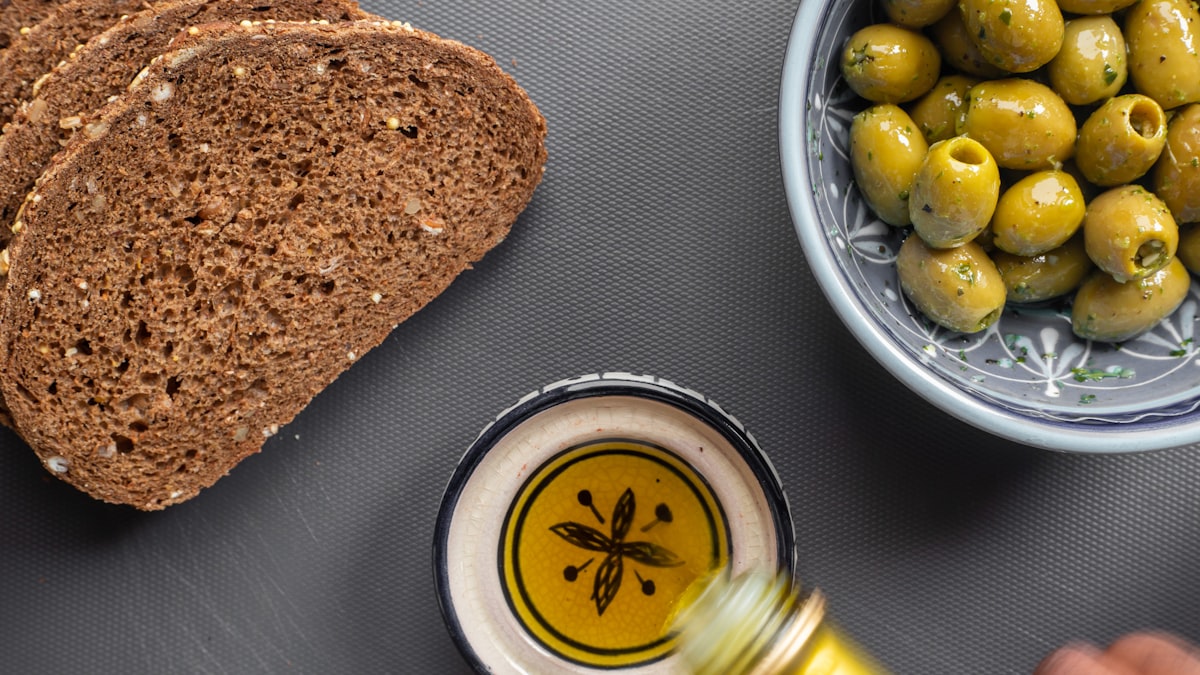
A point researchers return to repeatedly is the limitation of viewing olive oil as an isolated functional ingredient. A fundamental methodological constraint in Mediterranean diet research is the difficulty of separating olive oil's effects from those of the broader eating pattern. The complex interactions that occur when olive oil is consumed alongside vegetables, whole grains, fish, and nuts have been reported to contribute to changes in inflammation markers, and pinpointing olive oil's independent contribution remains an active area of investigation.
A comprehensive 2022 review by Dinu et al. published in Advances in Nutrition reported that groups following the full Mediterranean diet tended to maintain lower levels of multiple inflammation markers. In this context, extra virgin olive oil is increasingly recognized as serving a role beyond that of a fat source — functioning as a primary dietary vehicle for phenolic compounds within the meal.
What to Look for When Choosing an Olive Oil
Nearly all olive oils used in inflammation-related research are classified as extra virgin grade. This distinction matters because the refining processes applied to produce pure olive oil or pomace oil remove a substantial portion of phenolic compounds. In many study designs, EVOO is selected explicitly as a source of phenolic compounds, not merely as a fat source.
Polyphenol content can vary considerably depending on harvest timing, cultivar, and storage conditions. Oils made from early-harvest olives tend to have stronger bitter and peppery notes and are generally understood to contain higher concentrations of oleocanthal and oleuropein-related compounds. Beyond the standard EVOO acidity threshold of 0.8% or below, products that disclose polyphenol content provide an additional reference point for assessing quality.
Research into olive oil's relationship with CRP and IL-6 remains active, and there are still more open questions than settled answers. What the body of evidence accumulated so far does consistently suggest is that regular consumption of extra virgin olive oil may not be unrelated to inflammation-associated markers — a direction that continues to attract serious scientific attention.
Frequently asked questions
- Does olive oil reduce CRP levels?
- Some studies, including the large PREDIMED trial published in JAMA Internal Medicine (2006), observed a tendency toward lower hs-CRP levels in participants who supplemented their diet with extra virgin olive oil. However, a 2020 meta-analysis in the European Journal of Nutrition noted high heterogeneity across studies, meaning results vary depending on intake amount, oil quality, and participants' baseline health status. It is too early to draw a definitive conclusion.
- What is oleocanthal and why does it come up in inflammation research?
- Oleocanthal is a secoiridoid compound responsible for the peppery throat sensation in fresh extra virgin olive oil. A study by Beauchamp et al. published in Nature in 2005 reported that oleocanthal inhibits COX-1 and COX-2 enzyme activity in a manner similar to ibuprofen. Those findings were from in vitro experiments, and researchers note it is too early to conclude that the same mechanism operates at the same intensity in the human body.
- How does olive oil affect IL-6?
- Most research on olive oil's phenolic compounds and IL-6 has been conducted in cell and animal models. A 2021 review by Illesca et al. in Antioxidants reported that oleuropein and hydroxytyrosol — key phenolic compounds in olive oil — may influence signaling pathways related to IL-6 secretion in macrophages. Human clinical evidence is still accumulating, and firm conclusions await larger randomized controlled trials.
- Does the type of olive oil matter for these studies?
- Yes. The vast majority of inflammation-related studies use extra virgin olive oil specifically, because refining processes used to produce pure olive oil or pomace oil significantly reduce phenolic compound content. In many study designs, EVOO is selected not simply as a fat source but as a source of phenolic compounds. EU regulation EC No 432/2012 requires a minimum phenolic content of 250 mg/kg for any health claim related to olive oil polyphenols.
- Can olive oil alone account for the anti-inflammatory effects seen in Mediterranean diet studies?
- Researchers consistently highlight this as a methodological challenge. A comprehensive 2022 review by Dinu et al. in Advances in Nutrition reported that groups following the full Mediterranean diet tended to maintain lower levels of multiple inflammation markers, but isolating the independent contribution of olive oil from vegetables, whole grains, fish, and nuts remains an ongoing area of research. The interaction of all these foods together is considered important.
Related reading
- Does Olive Oil You Eat Reach Your Skin? A Clinical Research Roundup
A growing body of clinical research is examining whether regular dietary intake of olive oil is associated with measurable changes in skin hydration and elasticity. This guide summarizes the current evidence, its limits, and how the findings sit within the broader context of Mediterranean eating patterns.
- Senescent Cells, Senolytics, and the Question of Olive Oil Polyphenols
The senolytic diet hypothesis has drawn attention to plant polyphenols as potential allies against aging cells. This guide maps where extra virgin olive oil's oleocanthal and related phenolic compounds currently sit in that research — and what the evidence cannot yet support.
- Olive Oil, Antioxidants, and Fatigue: A Guide to the Emerging Clinical Research
Extra virgin olive oil is drawing growing attention in oxidative stress and chronic fatigue research, with its polyphenols and oleic acid studied for potential roles in cellular energy metabolism. Here is what the current clinical evidence actually shows.
- Bone Health on the Table: What the Osteoblast and Calcitriol Research Says About Olive Oil
From oleic acid's reported role in osteoblast differentiation to calcitriol absorption and polyphenol activity, a growing body of cell and animal research links extra virgin olive oil to bone metabolism — though the clinical picture is still forming.
- Olive Oil and Inflammation: What Two Decades of Research Have Found
From oleocanthal's proposed COX-inhibiting mechanism to EFSA's conditional polyphenol claim, this guide traces what peer-reviewed research has — and has not — established about EVOO's role in an anti-inflammatory diet.
- Olive Oil, Cortisol, and Dietary Fat: Where the Research Actually Stands
Chronic stress and elevated cortisol have become defining health concerns of our time. A growing body of research is examining whether the type of dietary fat we consume — extra virgin olive oil in particular — may be linked to how the body regulates its stress response.
Tags
- inflammation
- extra virgin olive oil
- polyphenols
- CRP
- mediterranean diet