Craft
Why Vinaigrette Always Separates — and How to Slow It Down
Oil and vinegar repel each other at the molecular level, but emulsifiers like mustard and lecithin can hold them together long enough to matter. A food-science guide to building a more stable vinaigrette with extra virgin olive oil.
Translated from the Korean edition, originally published August 22, 2026 · read the original
Why Oil and Water Don't Mix
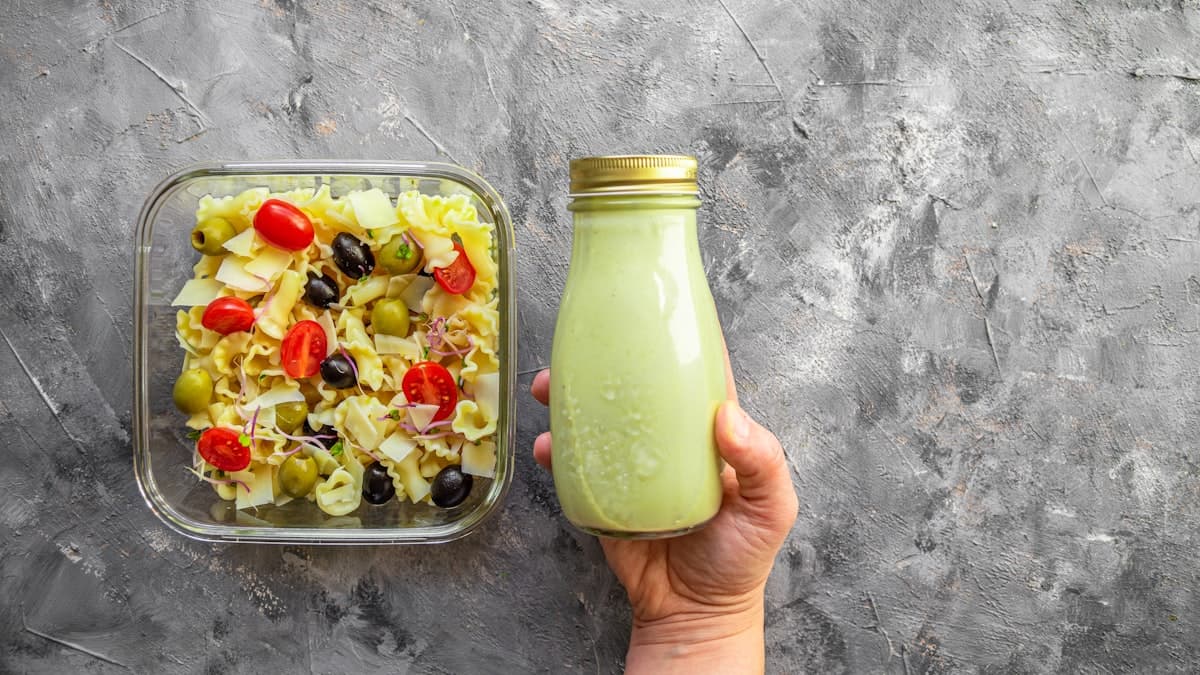
Anyone who has made a salad dressing knows the frustration: shake the jar as hard as you like, set it on the table, and within moments the golden oil layer and the clear vinegar layer pull cleanly apart again. The cause is a molecular-level difference in polarity.
Water is a polar molecule — one oxygen atom bonded to two hydrogen atoms — and its molecules cling to each other through strong hydrogen bonds, leaving no comfortable room for nonpolar intruders. The fatty acids that make up olive oil, principally oleic acid and linoleic acid, carry long nonpolar hydrocarbon chains that cannot settle among water molecules and are pushed to the interface between the two liquids. The result is that oil molecules cluster with oil and water molecules cluster with water, because that arrangement is far more energetically stable.
Forcing the two phases into a uniform mixture produces an emulsion. A vinaigrette is an oil-in-water (O/W) emulsion: tiny olive oil droplets suspended in an aqueous continuous phase. The problem is that an emulsion held together only by mechanical agitation breaks apart quickly.
What Emulsifiers Actually Do — Lecithin and Mustard
Keeping an emulsion stable requires molecules that can mediate between oil and water at the interface. These are called emulsifiers, or surfactants. An emulsifier molecule has a hydrophilic (water-friendly) head at one end and a lipophilic (oil-friendly) tail at the other. Arranged around each oil droplet, they form an interfacial film that prevents the droplets from coalescing.
The two most practical natural emulsifiers in a vinaigrette are lecithin and mustard.
Lecithin is a phospholipid whose main component is phosphatidylcholine, found abundantly in egg yolks, soybeans, and sunflower seeds. According to Harold McGee's On Food and Cooking — a standard reference in food science — lecithin molecules carry both a hydrophilic phosphate group and lipophilic fatty acid chains, which causes them to self-arrange spontaneously at the oil-water interface and deliver strong emulsifying power even in small amounts. A single egg yolk contains roughly 1.2–1.5 g of lecithin, enough to stabilize not only a vinaigrette but also more concentrated emulsion sauces such as mayonnaise.
Dijon mustard is another powerful emulsifying agent. Mucin-type glycoproteins and dietary fiber components found in mustard seeds adsorb at the interface, raise viscosity, and physically obstruct droplets from merging. Multiple culinary-science experiments have reported that a vinaigrette containing 1 teaspoon (about 5 g) of mustard shows a meaningfully delayed onset of phase separation compared with a control batch made without it.
Ratio, Order, and Temperature — the Conditions That Start an Emulsion
Having an emulsifier on hand does not guarantee an emulsion will form. The oil-to-vinegar ratio, the order in which ingredients are combined, and temperature all influence the outcome.
The classical French vinaigrette ratio is 3 parts oil to 1 part vinegar. At this ratio the vinegar (aqueous phase) becomes the continuous phase and olive oil can circulate as dispersed droplets within it. Push the oil fraction significantly higher — to 4:1 or beyond — and the continuous phase risks inverting to oil, producing a water-in-oil (W/O) emulsion or simply an unstable mixture that separates almost at once.
Order of addition matters just as much. The standard technique is to combine the emulsifier with the aqueous ingredients first — vinegar, lemon juice, salt — until everything is well dissolved, then pour the olive oil in slowly and in a thin stream while whisking vigorously. This gives the emulsifier molecules time to coat each newly formed droplet before the next one appears. Adding the oil all at once, or reversing the order, produces uneven droplet sizes and a less stable result.
Temperature is an easy variable to overlook. Olive oil stored in the refrigerator has partially solidified saturated fats that raise viscosity, and at low temperatures emulsifier molecules also move less freely. Making the dressing at room temperature — around 18–22 °C — allows oil droplets to disperse far more evenly.
How EVOO Cultivar and Quality Affect Emulsion Stability
The cultivar and processing method behind an olive oil introduce subtle differences in emulsion behavior. Extra virgin olive oil (EVOO) retains minor compounds that are absent from refined oils: tocopherols, squalene, wax esters, and polyphenols, among others.
A research team at the University of Bologna published findings in Food Chemistry reporting that emulsions made with high-polyphenol EVOO exhibited greater oxidative stability at the interfacial film, and that the oil droplets lost flavor more slowly to oxidation — a finding consistent with the broader body of research on polyphenols as antioxidant agents.
Oleic acid content also influences viscosity and therefore droplet formation. Oils from high-oleic cultivars such as Picual and Ojiblanca tend to flow freely at room temperature, which makes it comparatively easy to form uniform droplets. Conversely, poor-quality oils that have degraded significantly carry elevated free fatty acid levels that can actually interfere with interfacial film formation.
A Practical Checklist for a Vinaigrette That Holds Together
Translating the science above into kitchen practice comes down to five points.
First, always include an emulsifier. One teaspoon of Dijon mustard or half an egg yolk's worth of lecithin is the baseline. Finely minced or grated garlic also contributes: pectin in the cell walls acts as a secondary emulsifier.
Second, respect the 3:1 ratio. Keep oil at three parts to every one part of vinegar. With a sharply acidic lemon juice you can stretch to 4:1, but beyond that the risk of separation rises steeply.
Third, add the oil slowly and agitate forcefully. Whisk vigorously or use a blender in short bursts while drizzling the oil in gradually. Smaller droplets — on the order of micrometers — have a higher surface-area-to-mass ratio, which means gravity separates them more slowly.
Fourth, consider a touch of viscosity. A small amount of honey or syrup raises the viscosity of the aqueous phase and slows the rate at which oil droplets rise — a technique food scientists call rheological stabilization.
Fifth, store and revive correctly. Keep the finished dressing in a sealed container in the refrigerator. Before serving, leave it at room temperature for about 10 minutes, then shake well; this restores the texture close to its freshly made state.
One honest note to close with: every vinaigrette will eventually separate. Even combining lecithin and mustard, the stability ceiling without commercial emulsifiers is somewhere between a few hours and a day. Understanding that physical-chemistry reality — and getting into the habit of shaking the dressing fresh each time — is, in the end, the final step toward a truly great bowl.
Frequently asked questions
- Why do olive oil and vinegar always separate in a vinaigrette?
- Water molecules are polar and form strong hydrogen bonds with each other, leaving no stable space for the nonpolar fatty acid chains in olive oil. The two phases will always seek to minimize contact, so without an emulsifier holding them apart, separation is thermodynamically inevitable.
- Does Dijon mustard really work as an emulsifier?
- Yes. Mustard seeds contain mucin-type glycoproteins and dietary fiber that adsorb at the oil-water interface, increase viscosity, and physically hinder oil droplets from merging. Multiple culinary-science experiments have reported that adding just 1 teaspoon (about 5 g) of mustard meaningfully delays phase separation compared with a control vinaigrette made without it.
- What is the best oil-to-vinegar ratio for a stable vinaigrette?
- The classical French ratio is 3 parts oil to 1 part vinegar. At this ratio the vinegar forms the continuous phase and olive oil disperses within it as small droplets. Pushing beyond 4:1 risks inverting the phases or producing an unstable mixture that separates almost immediately.
- Does the type of extra virgin olive oil affect how well a vinaigrette emulsifies?
- To a degree, yes. Research published in Food Chemistry by a team at the University of Bologna reported that emulsions made with high-polyphenol EVOO showed greater oxidative stability at the interface, meaning the oil droplets resisted flavor-degrading oxidation longer. Cultivars naturally high in oleic acid — such as Picual and Ojiblanca — also tend to flow more freely at room temperature, which helps produce more uniform droplet sizes.
- How long will a homemade vinaigrette stay emulsified?
- Even with both mustard and egg-yolk lecithin, a vinaigrette made without commercial emulsifiers will typically hold for a few hours to, at most, a day before visibly separating. The practical solution is to store it in a sealed container, let it come to room temperature for about 10 minutes before serving, and give it a good shake to re-emulsify.
Related reading
- Extra Virgin vs. Pure Olive Oil: A Shelf-Side Buying Guide
Two bottles, side by side, same country of origin — yet the price gap can be substantial. Here is what the IOC grade standards, label rules, and food-science research say about choosing between extra virgin and pure olive oil.
- Chili, Pepper, Cumin: A Beginner's Guide to Infusing EVOO with Spices
Infusing extra virgin olive oil with dried chili flakes, peppercorns, or cumin is one of the most approachable ways to build a flavored oil at home. Temperature control and basic hygiene are the deciding factors between a great result and a wasted bottle.
- Cold Press, Early Harvest, and the Clock Running Between Them
Two phrases appear on nearly every premium EVOO label — cold press and early harvest. Behind the marketing language lie hard constraints: pressing temperature, the ripeness window, and the hours between harvest and mill.
- Cold Press or Washed Extraction: The Process That Shapes Every Drop of Flavor
Cultivar and origin get most of the credit, but the extraction method may matter just as much. A guide to how cold press and washed extraction differ — and what those differences mean in the bottle.
- Fruity, Bitter, Pungent: The Three Scores That Decide an EVOO's Grade
Every EVOO tasting note circles back to the same three words. Here is how IOC sensory panels actually use them — and why all three must be present for a oil to hold its extra virgin status.
- "Bottled in Italy" vs. "100% Italian Olives": Two Phrases, Two Very Different Meanings
The Italian flag on an olive oil label can mean almost anything — or almost nothing. A practical guide to decoding origin labeling and spotting the legal ambiguity hiding in plain sight.
Tags
- vinaigrette
- emulsion
- food science
- olive oil dressing
- evoo