Craft
Beyond the Meter's Limit — What ORO CELESTE Picual's Lab Report Actually Says
ORO CELESTE Picual's certificate of analysis carries a notation that its polyphenol reading exceeded the instrument's quantification limit. Here is a calm, precise look at what that number means in the context of olive oil quality.
Translated from the Korean edition, originally published July 21, 2026 · read the original
A Notation That Stops Careful Shoppers in Their Tracks
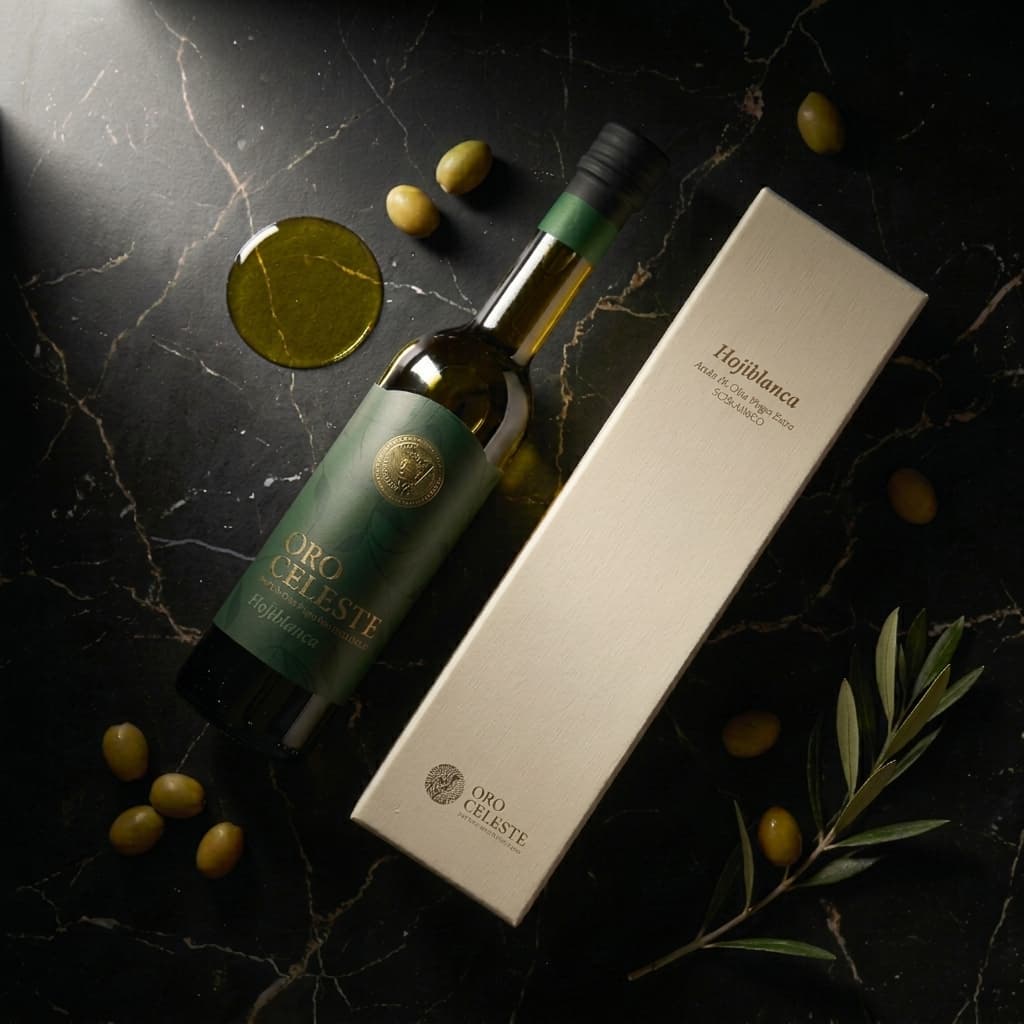
Anyone who studies an olive oil product page seriously has probably opened a Certificate of Analysis (COA) — that document listing acidity, peroxide value and polyphenol content in neat rows. On the polyphenol line of the ORO CELESTE Picual COA, a phrase appears that is not common: '>LOQ (Limit of Quantification)', sometimes written as '800+ mg/kg'.
At first glance, two opposite readings seem possible. Either the instrument failed to capture the number properly — or the concentration was so high that it ran off the scale. The second reading is the correct one.
What LOQ Means — The End of the Instrument's Ruler
In analytical chemistry, the Limit of Quantification is the upper boundary at which a measuring instrument can report a trustworthy figure. The polyphenol methods most widely used by accredited laboratories and EU olive oil certification bodies — Folin-Ciocalteu and HPLC-based assays — typically set their reliable quantification ceiling at roughly 600–800 mg/kg. A sample that exceeds that threshold is not unreadable; it simply sits beyond the end of the instrument's ruler.
According to IOC polyphenol analysis guidelines, total polyphenol content in mainstream extra virgin olive oils is generally distributed between 50 and 500 mg/kg, and oils above 500 mg/kg are reported to qualify as high-polyphenol grade. Readings that surpass 800 mg/kg account for only a small fraction of the global EVOO market.
The Structural Reasons Picual Reads So High
A high polyphenol result is shaped by origin, harvest timing and, above all, the cultivar's own biochemistry. Picual — native to Spain's Jaén province — is recognised for accumulating exceptionally rich concentrations of secoiridoid phenolic compounds, particularly oleocanthal and oleacein.
A cultivar comparison study published by Spain's National Research Council (CSIC) reported that Picual showed average total phenol content 1.4 to 2 times higher than major cultivars such as Arbequina and Cornicabra under equivalent harvest and milling conditions. That advantage is amplified further when an early-harvest approach is used.
ORO CELESTE Picual publishes its own measured values: acidity 0.20% and polyphenols 800+ mg/kg. An acidity of 0.20% sits well below the extra virgin threshold of 0.8%, and is generally read as an indicator that both freshness and milling quality were high at the point of harvest.
How to Read the Numbers — Three Contexts That Matter
A COA figure only tells its full story when placed in context. Three factors deserve attention.
First, the measurement method. Total polyphenols are measured by the Folin-Ciocalteu method; individual phenolic compounds such as oleocanthal and oleacein are identified by HPLC-DAD. It matters which method produced the figure you are looking at — the two approaches can yield different readings from the same sample.
Second, the harvest batch. Polyphenol content shifts from year to year and even from one picking date to the next within a single season. A COA is a snapshot of one specific lot. Where a brand publishes lot-specific certificates — as ORO CELESTE does — it is worth confirming that the lot number on the bottle matches the lot number on the document.
Third, what the '>800' notation actually signals. Some readers intuit that a '>' sign conceals the real number. In fact it does the opposite: it transparently discloses the instrument's limit rather than fabricating a figure beyond its reliable range. Laboratories can obtain a more precise reading by diluting the sample and re-running the assay, but that requires a separate additional analysis.
What Changes When Polyphenols Are High
High-polyphenol oils are also distinguishable by taste. The peppery catch at the back of the throat — pungency — and pronounced bitterness are the sensory signatures of oleocanthal and oleacein respectively.
In 2011, the European Food Safety Authority (EFSA) approved a qualified health claim stating that olive oil polyphenols are associated with protection of LDL cholesterol from oxidative stress when the oil contains at least 250 mg/kg total phenolic compounds and is consumed at 20 g per day (EFSA Journal 2011;9(4):2033). That claim is strictly conditional under EU regulation and is categorically separate from any disease-prevention or treatment language.
The Picual's 800+ mg/kg sits at more than three times that reference level. Even so, it is too early to conclude that any specific polyphenol figure guarantees a defined outcome for an individual; the broader context of a person's diet and eating habits always plays a role.
A Reader's Guide to the Certificate of Analysis
The key figures to check on any olive oil COA are free fatty acidity, peroxide value, total polyphenols and — where available — an individual phenolic compound profile. If the polyphenol line shows '>800' or '800+ mg/kg', treat it as context rather than confusion. It is not a defect flag. It indicates that the concentration exceeded the instrument's quantification ceiling — placing the oil firmly in high-polyphenol territory.
ORO CELESTE Picual carries that notation not to overstate or obscure a number, but because publishing the honest boundary of what the measurement reached is where quality transparency begins. Learning to read a single figure correctly is the first skill of choosing excellent olive oil.
Frequently asked questions
- What does '>LOQ' or '>800 mg/kg' mean on an olive oil certificate of analysis?
- LOQ stands for Limit of Quantification — the upper boundary at which an analytical instrument can report a reliable figure. A reading of '>800 mg/kg' means the polyphenol concentration exceeded that ceiling; it is not a measurement error. The actual value is at or above 800 mg/kg, and the notation is a transparent acknowledgment of the instrument's range rather than a sign of any defect.
- Is 800 mg/kg polyphenols unusually high for extra virgin olive oil?
- Yes. According to International Olive Council (IOC) guidelines, most extra virgin olive oils fall between 50 and 500 mg/kg total polyphenols, and oils above 500 mg/kg are reported to qualify as high-polyphenol grade. Readings that exceed 800 mg/kg represent only a small fraction of the global EVOO market.
- Why does Picual olive oil tend to have higher polyphenols than other cultivars?
- Picual, native to the Jaén region of Spain, is known for accumulating particularly high concentrations of secoiridoid phenolic compounds — including oleocanthal and oleacein. A comparative cultivar study published by Spain's National Research Council (CSIC) reported that, under equivalent harvest and milling conditions, Picual showed average total phenol content 1.4 to 2 times higher than major cultivars such as Arbequina. Early-harvest practice tends to push those figures even higher.
- Does a higher polyphenol count guarantee health benefits?
- Not as a guarantee. EFSA issued a qualified health claim in 2011 (EFSA Journal 2011;9(4):2033) recognising that olive oil polyphenols are associated with protection of LDL cholesterol from oxidative stress when the oil contains at least 250 mg/kg total phenolic compounds and is consumed at 20 g per day. That claim is strictly conditional under EU regulation and is categorically separate from any disease-prevention or treatment language. It remains too early to conclude that any specific polyphenol level produces a defined health outcome for an individual; dietary context always matters.
- How do I match a lot number on an olive oil label to its certificate of analysis?
- Brands that publish batch-specific certificates — as ORO CELESTE does — print a lot number on the bottle. Cross-reference that number with the lot number shown at the top of the COA. If they match, the acidity, peroxide value and polyphenol figures on the document correspond exactly to the oil in your bottle. If no lot number is visible, the certificate covers a broader production run and should be read as representative rather than definitive for your specific bottle.
Related reading
- Every Bottle, Its Own QR Code: Inside ORO CELESTE's Batch Traceability System
ORO CELESTE attaches a unique QR code to each production batch, linking directly to that batch's certificate of analysis. This guide explains why acidity and polyphenol figures shift from batch to batch — and what genuine transparency on the label is actually worth to a buyer.
- ORO CELESTE Discloses Lab-Certified Polyphenol Counts — Picual Exceeds 800 mg/kg Detection Limit
ORO CELESTE has published certified lab figures for three single-varietal extra virgin olive oils directly on labels and its official website. Picual tested above the instrument detection limit at 800 mg/kg or more; Ojiblanca and Sibarita came in at 600 mg/kg or more and 500 mg/kg or more, respectively.
- ORO CELESTE Picual Deep Dive — Peppery Intensity and Off-the-Chart Polyphenols
ORO CELESTE's Picual registers an acidity of 0.20% and polyphenols above 800 mg/kg — figures that push standard laboratory instruments to their measurement limits. This guide examines what those numbers mean and why this oil's peppery finish is in a category of its own.
- The Cultivar Decides — Koroneiki, Picual and Arbequina Polyphenols Compared
Polyphenol levels in extra virgin olive oil can vary by a factor of ten or more depending on cultivar. This data-driven guide compares the polyphenol content and flavor profiles of three benchmark varieties: Greece's Koroneiki and Spain's Picual and Arbequina.
- Reading Polyphenol Numbers on an Olive Oil Label: A Step-by-Step Comparison Guide
The mg/kg polyphenol figure printed on an extra virgin olive oil bottle is one of the most useful quality signals a label can carry — but only if you know how to read it. This guide walks through what the number means, how measurement method affects it, and what else to check alongside it.
- Closer to the Source: A Practical Guide to Buying Olive Oil Direct from Producers
From farm-direct shipping and micro-importers to group buys, there are more ways than ever to reach a producer before a supermarket shelf does. This guide walks through each route, what to verify before you buy, and how to set realistic expectations on price and freshness.
Tags
- picual
- polyphenols
- extra virgin olive oil
- certificate of analysis
- high polyphenol
- craft