Guides
Organic EVOO Certifications Decoded: Euro-leaf, USDA, and Demeter
Three certification marks — the EU Euro-leaf, USDA Organic, and Demeter — divide the organic EVOO shelf into meaningfully different tiers. Understanding what each one actually requires makes it far easier to judge whether the premium is worth paying.
Translated from the Korean edition, originally published September 21, 2023 · read the original
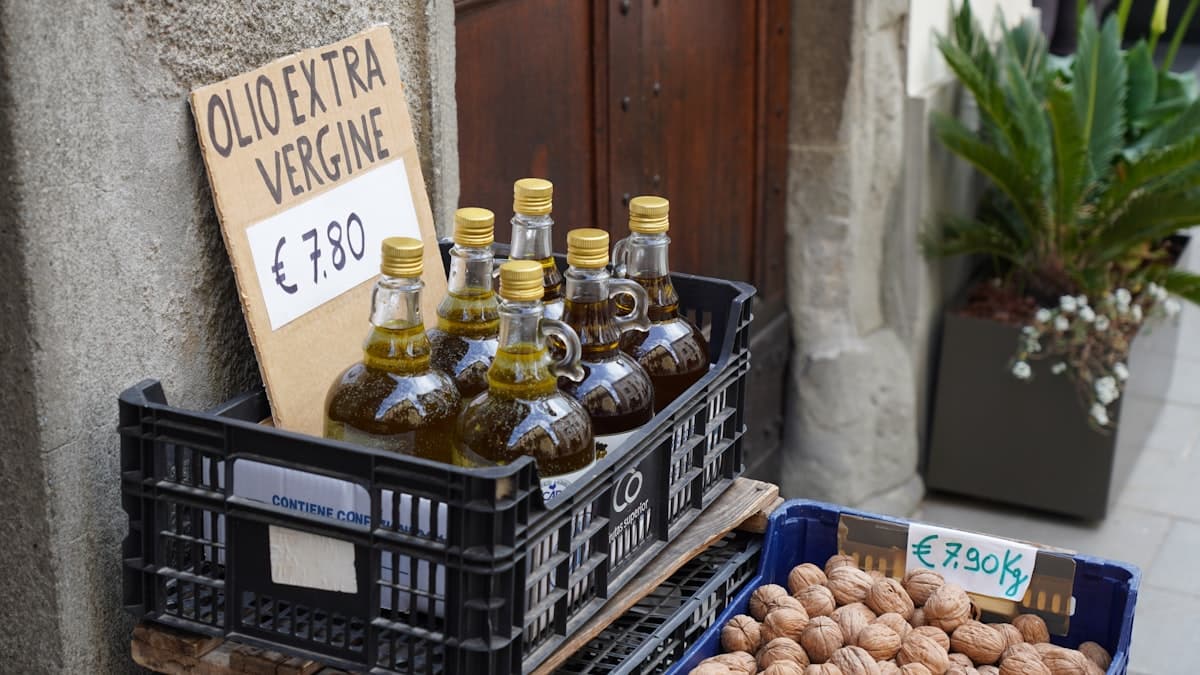
A certified-organic EVOO routinely sits 1.5 to 2 times the price of its conventional counterpart on the same shelf. The intuition that a higher price signals higher quality is understandable, but what actually separates these bottles is the certification framework and the operational costs behind it. Getting clear on what each mark requires makes the decision at the shelf considerably easier.
The EU Euro-leaf — the Mark You Will See Most Often
The certification that appears most frequently on EVOO sold internationally is the EU organic mark, commonly known as the Euro-leaf: a green leaf composed of stars, printed on the front label. EU organic regulations require that at least 95% of agricultural ingredients are certified organic, with no GMOs, no synthetic pesticides, and no synthetic fertilisers. A certifying-body code — formatted something like "IT-BIO-009" — is usually printed alongside the logo; tracing that code identifies the inspection body responsible for the audit. The EU and United States have mutual-recognition arrangements for organic processed foods, meaning a bottle carrying the Euro-leaf generally meets USDA Organic requirements without separate re-certification.

USDA Organic and Demeter — the Same Word, Different Depth
USDA Organic shares the Euro-leaf's core pillars: no synthetic pesticides or fertilisers, no GMOs, and documented traceability through a USDA-accredited certifier. On the international shelf it appears frequently on oils that have passed through US distribution channels and on large-format retail private-label lines. Demeter occupies a different category. Founded in Germany in 1928, the Demeter association certifies biodynamic farming — a method that treats the soil and the farm as a single living organism, with planting and harvesting guided by ecological cycles and strict input rules that go well beyond the organic baseline. Demeter-certified oils typically command a price premium over EU- and USDA-certified equivalents, reflecting both the more demanding audit and the additional constraints on farm management. The word "organic" covers both, but the operational philosophy and cost structure sitting behind that word differ meaningfully between a USDA-certified bulk line and a Demeter-certified single-estate bottle.
How the Certified-Organic Shelf Breaks Down in Practice
Among widely distributed organic EVOO lines, Monini of Italy offers a useful reference. The brand's organic monocultivar range — built around single varieties such as Coratina and Nocellara — is bottled in 500 ml dark glass and carries the EU organic mark. Costco's Kirkland Signature organic line takes a different position: a 2-litre format carrying both the USDA Organic and Euro-leaf marks, priced so that the per-millilitre cost sits below most 500 ml single-estate organic bottles. At the premium end, single-estate producers whose entire certified-organic output is small by design — Castillo de Canena's biodynamic Arbequina is one example covered elsewhere in OLEA — occupy a distinct price tier, where certification combines with low yield and harvest precision to support a significantly higher per-bottle price.
What Certification Does and Does Not Guarantee
The price gap between a conventional EVOO and its certified-organic equivalent from the same producer generally runs 1.3 to 2 times. That gap reflects three cost drivers: the yield reduction that comes from farming without synthetic inputs, third-party inspection fees, and the administrative cost of maintaining certified supply chains. What organic certification does not automatically confer is a higher polyphenol count or a lower acidity reading. As explored in OLEA's guide to acidity and polyphenols, those figures vary by cultivar, harvest date, and milling conditions — not by whether the olives were grown without pesticides. Organic certification is a verifiable promise about farming method. Freshness and phenolic richness are separate questions, answered by the harvest year on the label and, where available, the producer's technical data sheet.
Acidity figures, polyphenol data, and retail pricing vary by import date, exchange rate, and retailer promotions. Always check the label at the point of purchase for the most accurate information.
Frequently asked questions
- What does the Euro-leaf certification mean on an olive oil bottle?
- The Euro-leaf (EU organic) mark — the green leaf logo on the front label — requires that the product contains at least 95% certified organic ingredients and excludes GMOs, synthetic pesticides, and synthetic fertilisers. A certifying-body code such as 'IT-BIO-009' typically appears alongside it, allowing the inspection body to be traced.
- Is USDA Organic the same standard as EU organic for olive oil?
- The two schemes share the same core requirements — no synthetic pesticides or fertilisers, no GMOs — and the EU and US have mutual recognition agreements covering many organic products. In practice the standards are broadly equivalent, though the certifying bodies and audit procedures differ.
- What makes Demeter certification stricter than regular organic?
- Demeter, founded in Germany in 1928, adds biodynamic farming requirements on top of the organic baseline. The entire farm must be managed as a unified living system. That additional layer of auditing and the more restrictive growing calendar typically place Demeter-certified oils at a higher price point than EU- or USDA-certified equivalents.
- Does an organic certification guarantee higher polyphenols or lower acidity?
- No. Organic certification is a promise about farming method, not about the sensory or chemical quality of the finished oil. Acidity and polyphenol levels depend on cultivar, harvest timing, and milling practice — factors assessed separately and sometimes noted on the label or the producer's technical sheet.
- Why does organic EVOO cost more than conventional?
- The premium typically reflects lower yields from pesticide-free growing, additional inspection and certification fees, and the cost of maintaining separation from non-organic supply chains. The price gap between a conventional and a certified-organic line from the same producer commonly runs 1.3 to 2 times.
Related reading
- Six Supermarket EVOOs, Ranked by Acidity and Origin
From a sub-1% acidity Spanish single-estate to entry-level Korean-imported blends, six widely available extra virgin olive oils are compared on the facts that actually matter at the shelf.
- Daily EVOO Under $20: How to Read the Shelf and Pick the Right Bottle
Two bottles labeled 'extra virgin' can sit side by side at very different prices — and both can be the right choice, depending on how fast you cook through them. Here is how to read the signals that matter in the budget tier.
- Kirkland, No Brand, Signature: A Guide to Superstore Private-Label EVOO
Costco's Kirkland Signature, E-Mart's No Brand, and Homeplus Signature all offer private-label extra virgin olive oil at prices below comparable global brands. Here is how each line positions itself — and what the label does and does not tell you.
- Four Price Tiers of Extra Virgin Olive Oil — and What Each One Actually Buys You
From entry-level PET-bottle blends to single-estate premiums, the EVOO shelf divides into four distinct tiers. Knowing what separates them makes it easier to shop with intention.
- Single Estate, Finca, Tenuta: How One Phrase Became a Global Transparency Standard
From Spain's finca to Italy's tenuta and beyond, the single-estate designation has spent three decades shaping what premium EVOO transparency actually looks like — and what separates the producers who can prove their claims from those who cannot.
- Premium EVOO at Every Price Point: A Global Farm Map
Within the global premium EVOO tier, estates cluster around a consistent set of signals — single origin, single cultivar, and published lab results. This guide charts the farms and labels that define that space, from Andalusia to California.