Table
5,000 Years in a Bottle: From Minoan Crete to EU Regulation
The golden oil first pressed by Minoan hands on Crete passed through Egyptian tombs, Roman amphoras, and medieval monasteries before arriving at the legal frameworks that govern every bottle on the shelf today. A guide to olive oil's full arc of history.
Translated from the Korean edition, originally published July 8, 2026 · read the original
One Seed That Shifted Civilization
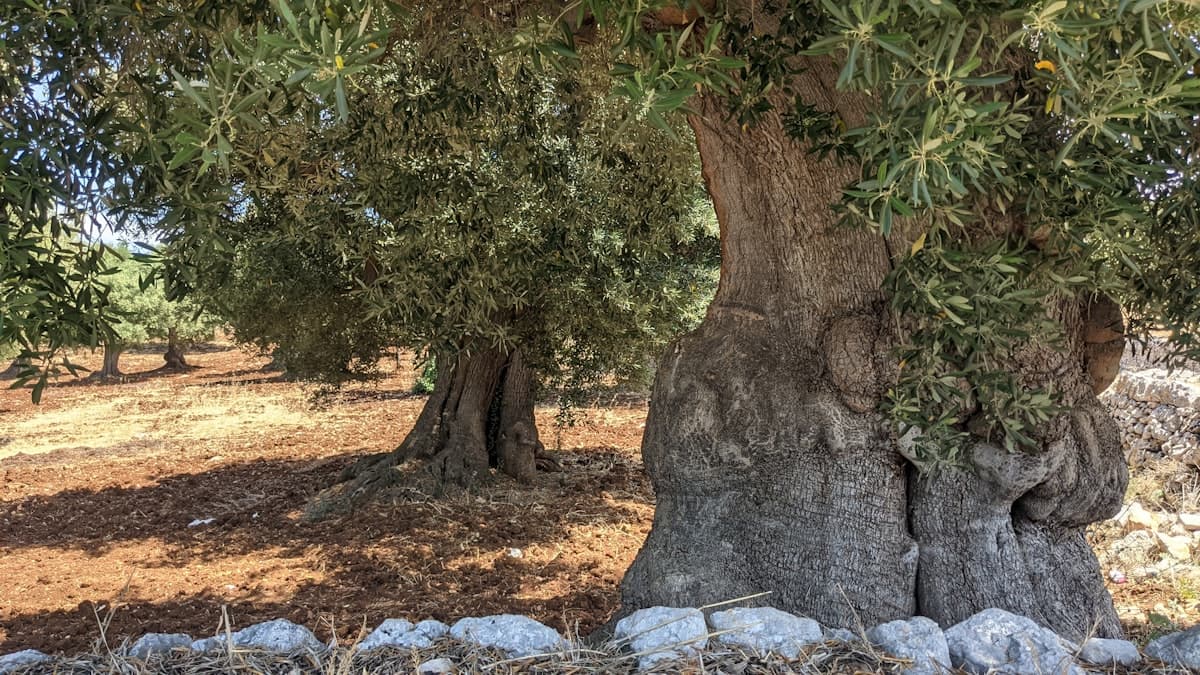
The cultivation of the olive tree (Olea europaea) traces back to around 3000 BCE on the eastern shores of the Aegean. Archaeological evidence indicates that the Minoan civilization, which flourished on Crete, was the first to cultivate wild olives systematically and extract their oil on an organized scale. Clusters of large storage jars known as pithoi, unearthed near the Palace of Knossos, show that olive oil production and distribution were already a cornerstone of the palace economy. In his excavation reports from Knossos, British archaeologist Arthur Evans described finding hundreds of jars stacked in layers within certain storerooms; residual organic analysis identified olive oil components in a significant number of them.
Traces of olive oil appear at roughly the same period along the Levantine coast and in ancient Egypt. A small limestone vessel containing olive oil was found among the burial goods in the tomb of Tutankhamun, who died in 1323 BCE. Egyptologists interpret the inclusion as provision for the king's feasting in the afterlife. By the Bronze Age, in other words, olive oil had already become both a food and a ritual substance.
Greece and Rome: An Empire Built on Golden Oil
For ancient Greeks, the olive tree carried mythological weight. The legend that the goddess Athena gave the city of Athens its first olive tree as a founding gift signals how completely olive oil was bound up with Greek civic identity. Ancient sources record that the sixth-century BCE law code of Solon prohibited the indiscriminate felling of olive trees, with death listed as the penalty for serious violations.
Cultivated olive acreage expanded dramatically under Rome. The agronomist Columella, writing in the first century CE in De Re Rustica, recorded cultivar-by-cultivar growing methods and pressing techniques with a systematism that reads almost like an early quality manual. Hispania — roughly present-day Andalusia — grew into the Roman Empire's largest olive oil producing region. Near Seville, a hill known as Monte Testaccio is composed almost entirely of broken amphora sherds that once held olive oil shipped to Rome. According to excavation reports by the Deutsches Archäologisches Institut Rom, the volume represented by those fragments suggests that annual imports from Hispania to the Italian mainland ran to millions of litres.
The Medieval Lamp: Byzantine and Islamic Continuity
When the Western Roman Empire fell in 476 CE, olive oil culture did not collapse with it. The Eastern Roman (Byzantine) Empire inherited the olive-growing traditions of the eastern Mediterranean, and within the monastery economy, olive oil was an indispensable resource for food, lighting, and liturgical use alike. Across medieval Western Europe, monasteries assumed the role of producing, distributing, and — crucially — documenting pressing techniques, ensuring that accumulated knowledge survived into the following centuries.
The expansion of the Islamic world carried olive cultivation deep into the North African interior and across the Iberian Peninsula. Arab agronomists developed irrigation methods that raised olive productivity in arid zones, and that knowledge eventually traveled with Spanish and Portuguese colonizers to South America. From the sixteenth century onward, olive seedlings were planted in Peru and Chile, providing the founding stock for what are today significant Southern Hemisphere producing industries.
The Nineteenth-Century Science Revolution and the Language of Quality
Chemical analysis entered olive oil history around the mid-nineteenth century. French chemist Michel-Eugène Chevreul's foundational research on fatty acids drew attention to free fatty acid content as a measurable indicator of oil quality. From that work emerged the principle that lower acidity signals fresher oil that has been handled correctly — a concept still embedded in every quality standard in use today.
Formal grade-classification discussions began in Italy and Spain in the early twentieth century, and in 1959 the International Olive Council (IOC) was established, marking the beginning of genuine international standardization. The IOC now counts 46 member countries and functions as the central body for standardizing quality criteria, analytical methods, and sensory evaluation through trained tasting panels. According to official IOC data, extra virgin olive oil (EVOO) must simultaneously satisfy multiple chemical thresholds: free fatty acid content of no more than 0.8%, and a peroxide value no greater than 20 meq O₂/kg, among other parameters.
EU Regulation: Five Thousand Years Codified into Law
The European Union began converting olive oil grade standards into binding legislation with Regulation EEC No 2568/91 in 1991. After several revisions, EU Regulation No 29/2012 and related delegated regulations now provide comprehensive rules covering labelling, quality standards, and origin declarations. The Protected Designation of Origin (PDO) and Protected Geographical Indication (PGI) systems grant legal protection to oils from specific regions, offering consumers a verifiable guarantee of provenance. According to European Commission data, more than 150 olive oil products held PDO or PGI certification within the EU as of 2023.
Deepening quality controls have in turn intensified scientific interest in oil biochemistry. As research accumulates on how polyphenol content affects both the flavour and the oxidative stability of EVOO, specialists are moving beyond acidity as the sole quality marker toward a more comprehensive picture that includes phenolic compounds, aromatic profiles, and harvest timing. In 2011, the European Food Safety Authority (EFSA) approved a conditional health claim linking the consumption of specific olive polyphenols — including oleocanthal and oleacein — to biomarkers associated with oxidative stress. The approval is frequently cited as an example of how regulation, when sufficient scientific evidence has accumulated, can itself become part of the historical record.
This Moment Is Already History
The story that began in a Bronze Age pressing room on Crete is opening a new chapter in the hands of consumers who scan a QR code on a bottle to trace it to its grove. According to the IOC World Olive Oil Market Report (2023/24), global EVOO production stands at approximately 3.5 million tonnes, with Spain, Italy, Greece, and Turkey together accounting for more than 80% of that output. The golden oil that fed and illuminated Mediterranean civilization for five millennia now arrives at tables around the world carrying both the weight of that history and the precision of modern science.
Frequently asked questions
- Where was olive oil first produced?
- Archaeological evidence points to the Minoan civilization on Crete as the earliest organized producers of olive oil, dating to around 3000 BCE. Large storage jars (pithoi) excavated near the Palace of Knossos contained residues identified as olive oil, indicating that production and distribution were already central to the palace economy.
- How did the Romans spread olive oil production across Europe?
- Rome transformed olive oil from a regional commodity into an empire-wide industry. Hispania — roughly modern Andalusia — became the empire's largest producing region. The sheer volume of amphora fragments piled at Monte Testaccio near Seville led the Deutsches Archäologisches Institut Rom to estimate that imports from Hispania to Rome reached millions of litres annually.
- When were international olive oil quality standards first established?
- The International Olive Council (IOC) was founded in 1959 and launched the first formal international standardization effort. According to IOC official data, extra virgin olive oil must meet multiple chemical thresholds simultaneously, including free fatty acid content of no more than 0.8% and a peroxide value no greater than 20 meq O₂/kg.
- What EU regulations govern olive oil labelling and quality today?
- The EU began codifying olive oil grades into law with Regulation EEC No 2568/91 in 1991. After several revisions, EU Regulation No 29/2012 and related delegated regulations now comprehensively govern labelling, quality standards, and origin declarations. The European Commission reported that, as of 2023, more than 150 olive oil products held PDO or PGI certification within the EU.
- Does the EU recognize any health claims related to olive oil polyphenols?
- In 2011, the European Food Safety Authority (EFSA) approved a conditional health claim linking the consumption of specific olive polyphenols — including oleocanthal and oleacein — to markers associated with oxidative stress. The claim is subject to strict conditions and does not mean that olive oil prevents or treats any disease; it reflects an association observed under defined intake levels.
Related reading
- Guacamole, Tacos, and Olive Oil: A Pairing That Goes Back Centuries
From sixteenth-century Spanish missionaries to modern Latin kitchens in Mexico City, New York, and Los Angeles, extra virgin olive oil has long had a place at the Mexican table. This guide traces the history and explores how chefs are using it today.
- Hummus, Shakshuka, Sabich: How Israeli Cooking Uses Olive Oil at Every Layer
From the finishing pour on hummus to the base of a shakshuka and the layered construction of a sabich, olive oil functions as a primary ingredient on the Israeli table — not a neutral medium. This guide traces how Levantine culinary tradition treats the oil itself as the point.
- Walnuts, Almonds, Pine Nuts: Pairing Three Nuts with EVOO
Extra virgin olive oil and nuts share a common language of unsaturated fats — and that structural kinship shapes how their flavors interact. A closer look at what happens when walnuts, almonds, and pine nuts meet EVOO on the plate.
- Athena's Gift: The Myth Behind the Olive Tree and Extra Virgin Olive Oil
When Athena struck the ground on the Acropolis and an olive tree rose from the rock, she won a city — and set in motion one of civilization's oldest agricultural stories. Tracing that myth forward to the bottle of EVOO on your table reveals how little the meaning of the olive has changed.
- Sacred Oil: Olive Oil's Ancient Role in Orthodox and Catholic Ritual
For thousands of years, Orthodox and Catholic traditions have placed olive oil at the center of baptism, anointing, and consecration rites. This is the story of how a pressed fruit became the Mediterranean world's most enduring sacred substance.
- A Drop of Gold: Olive Oil's Most Memorable Moments on Screen
From Italian neorealism to Greek wedding comedies, filmmakers across the Mediterranean have long used extra virgin olive oil as a visual language — one that communicates identity, belonging, and memory more directly than dialogue.
Tags
- history
- extra virgin olive oil
- evoo
- mediterranean
- eu regulation