Table
Sacred Oil: Olive Oil's Ancient Role in Orthodox and Catholic Ritual
For thousands of years, Orthodox and Catholic traditions have placed olive oil at the center of baptism, anointing, and consecration rites. This is the story of how a pressed fruit became the Mediterranean world's most enduring sacred substance.
Translated from the Korean edition, originally published July 22, 2026 · read the original
A Presence Older Than Written History
Olive oil enters the human religious imagination before the earliest written records. In the story of Noah's ark, the olive branch returned by the dove signified reconciliation between the divine and the human. Ancient Egyptians placed jars of olive oil beside royal mummies. Archaeological evidence from Minoan palace sites on Crete, dating to around 3000 BCE, includes large-scale olive oil storage vessels whose contents researchers associate substantially with religious offerings. Every ancient civilization around the Mediterranean regarded olive oil not merely as food but as a sacred substance — and that understanding passed intact into the Abrahamic traditions of Judaism, Christianity, and Islam.
The Hebrew Bible makes the point directly: olive oil appears in it more than 140 times. The anointing of kings and priests — the pouring of oil over a chosen person as an act of consecration — is among its most prominent ritual uses. The Hebrew word Mashiach and the Greek Christos both mean "the anointed one," which means that Christianity's central title for Jesus is itself rooted in an olive oil ceremony.
The Orthodox Church: A Theology of Light and Anointing
In the Eastern Orthodox tradition, olive oil is the material foundation of worship. The oil lamps — kandili — that burn before icons in churches and homes have traditionally been fueled by olive oil. As the flame rises from the oil, it is understood to signify divine presence: light drawn from the earth itself. In Greece, Cyprus, Serbia, Russia, Romania, and wherever living Orthodox communities exist, the practice of keeping an olive oil lamp burning before a household icon continues today.
The Euchelaion — the sacrament of Holy Unction, one of the seven sacraments of the Orthodox Church — is built entirely around olive oil. In it, a priest anoints a believer's forehead and hands with oil while reciting prayers on behalf of someone experiencing illness or suffering. The rite's emphasis is on spiritual renewal and communal solidarity rather than physical healing alone. On Holy Thursday, the Thursday immediately before Easter, many Orthodox churches hold a collective form of the Euchelaion open to the entire congregation. According to official figures from the Archdiocese of Athens, more than 70 percent of Greek Orthodox faithful are reported to participate directly in Holy Week services each year, with olive oil remaining an irreplaceable element at the center of those rites.
Olive oil is equally present at baptism. Before a candidate enters the baptismal font, the priest anoints the entire body with olive oil in a preliminary anointing. After baptism, a second anointing follows using Chrismation oil — a specially prepared holy oil in which olive oil is combined with around forty aromatic substances and consecrated by a patriarch. Each regional church receives its Chrismation oil from the Ecumenical Patriarchate in Constantinople (Istanbul) or from its own patriarch.
The Catholic Church: Seven Paths of Anointing
The Catholic Church similarly designates olive oil as the basis for its holy oils, using three distinct types in its liturgy. The Oil of Catechumens is used for the pre-baptismal anointing of those preparing for baptism. Sacred Chrism — olive oil blended with balsam — is used at baptism, confirmation, and ordination. The Oil of the Sick is used in the Anointing of the Sick. Under Catholic liturgical law, all three are specified to be made from vegetable oil, with olive oil explicitly preferred.
Each year on Holy Thursday morning — the Mass of the Lord's Supper — every diocesan bishop concelebrates the Chrism Mass with his presbyterate and blesses the oils that will serve the entire diocese for the coming year. The oils are then distributed to individual parishes for use in baptism, confirmation, the anointing of the sick, and ordination throughout the year. Theologians read the journey of the oil itself — from the cathedral to every local church — as a symbolic act expressing the unity and communion of the Christian community.
Where the Holy Land and the Olive Grove Are the Same Land
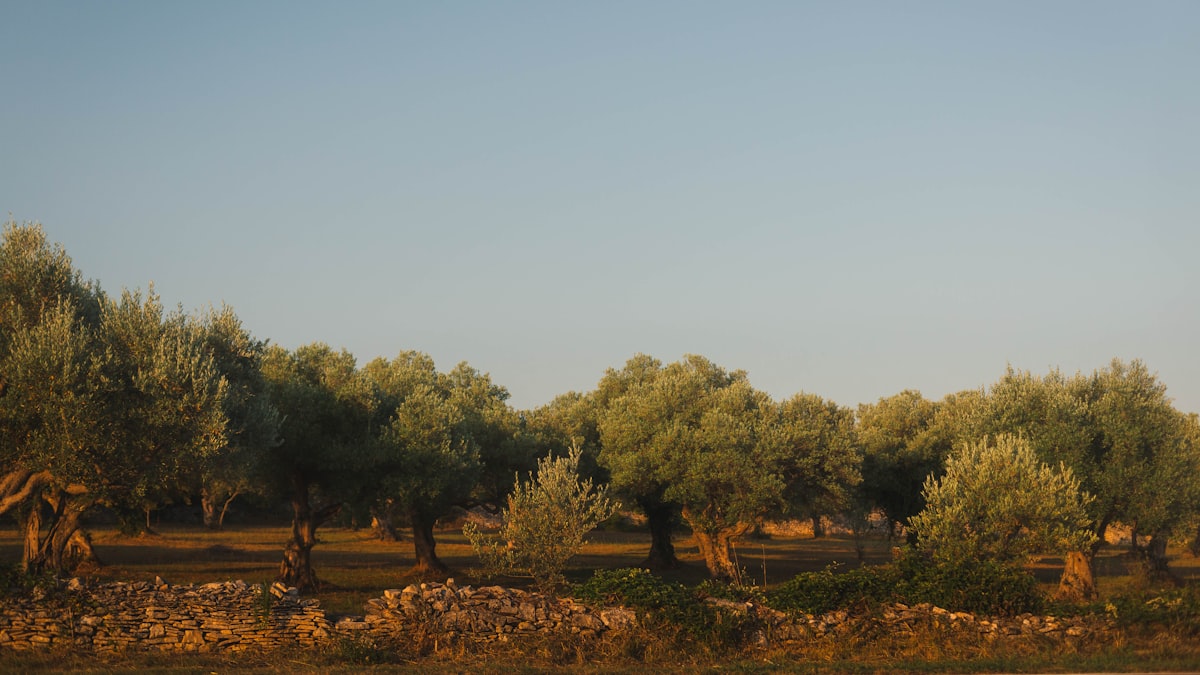
One of the more striking features of this history is the geographical coincidence: the principal olive-growing regions of the ancient world and the birthplaces of Christianity are the same places. Palestine, Syria, Greece, Italy, Spain, Portugal — all are both historic centers of olive cultivation and the territories where early Christian communities formed. According to figures from the International Olive Council (IOC), Mediterranean countries currently account for approximately 95 percent of global olive oil production, and olive cultivation in the region has been documented as far back as 5000 BCE.
In the Garden of Gethsemane in Jerusalem, olive trees estimated to be more than 2,000 years old are still living. The name Gethsemane itself comes from the Aramaic for "olive press" — the device used to crush olives and extract their oil. That Jesus is recorded as having prayed at the site of an olive press on the night before his death is a detail frequently interpreted by religious scholars as a symbol of purification through suffering, the same process by which pressure transforms a fruit into oil.
Oil That Survived Secularization
Industrialization and secularization have reshaped almost every aspect of religious practice, but olive oil's liturgical status has remained largely intact. If anything, a growing interest in local sourcing and the recovery of traditional practice has in recent years brought renewed attention to the origin and quality of oil used in ritual contexts. Some monasteries and dioceses now cultivate their own olives or contract directly with regional cooperatives to supply their liturgical oil. The monasteries of Mount Athos — the Greek peninsula that serves as a major pilgrimage site of Eastern Orthodoxy — have been reported to have grown their own olives and produced their own ritual oil for centuries, a tradition said to continue to this day.
The boundary between sacred and culinary olive oil is also more permeable than it might appear. In Ethiopian Orthodox and Coptic Christian communities, blessed olive oil is commonly brought home after a rite and used in everyday cooking. That the same oil can move freely between the altar and the kitchen table — between the sacred and the ordinary — is a reminder that olive oil resists simple categories. It is neither purely a food nor purely a ritual object, but something that has always belonged to both registers at once.
Across thousands of years, olive oil continues to burn on altars, float on baptismal water, anoint the foreheads of the sick, and glow quietly in small glass cups before gilded icons. The distance from the farmer's press to the sanctuary is, and has always been, shorter than it looks.
Frequently asked questions
- Why is olive oil used in Christian religious ceremonies?
- Olive oil carries deep symbolic weight throughout the Hebrew Bible — it is mentioned more than 140 times — and in early Christian practice. Its use in anointing kings and priests carried directly into Christian sacramental life, where it became the physical medium for baptism, confirmation, and healing rites in both Catholic and Orthodox traditions.
- What is Chrism oil and how is it made?
- Chrism is a consecrated oil used in Catholic and Orthodox sacraments. In the Catholic Church, it is made from olive oil and is blessed by a bishop at the Chrism Mass on Holy Thursday each year, then distributed to parishes for use in baptism, confirmation, and ordination. In Orthodox practice, the equivalent — Chrismation oil — is blended with around forty aromatic substances and consecrated by a patriarch.
- What is the Euchelaion in the Orthodox Church?
- The Euchelaion is one of the seven sacraments of the Eastern Orthodox Church. In it, a priest anoints a believer's forehead and hands with olive oil while offering prayers. Its focus is on spiritual restoration and communal support rather than physical cure alone. A collective form of the rite is often celebrated for the entire congregation on Holy Thursday.
- What does the name Gethsemane mean, and what is its connection to olive oil?
- Gethsemane comes from the Aramaic word for 'olive press' — the site where olives were crushed to extract oil. According to the Gospels, it is where Jesus prayed the night before his arrest. Religious scholars frequently interpret the symbolism of an olive press as a metaphor for purification through suffering, a reading made more vivid by the name's literal meaning.
- Do monasteries still produce their own olive oil for religious use?
- Some do. The monasteries of Mount Athos in Greece, an important pilgrimage site of Eastern Orthodoxy, have cultivated olive trees and produced their own ritual oil for centuries, a tradition that is reported to continue today. More broadly, a growing number of dioceses and monastic communities now source their liturgical olive oil directly from regional cooperatives or their own groves, reflecting a wider interest in local sourcing and the restoration of traditional practice.
Related reading
- 5,000 Years in a Bottle: From Minoan Crete to EU Regulation
The golden oil first pressed by Minoan hands on Crete passed through Egyptian tombs, Roman amphoras, and medieval monasteries before arriving at the legal frameworks that govern every bottle on the shelf today. A guide to olive oil's full arc of history.
- A Drop of Gold: Olive Oil's Most Memorable Moments on Screen
From Italian neorealism to Greek wedding comedies, filmmakers across the Mediterranean have long used extra virgin olive oil as a visual language — one that communicates identity, belonging, and memory more directly than dialogue.
- Caponata, Arancini, Granita: How Sicily Uses Olive Oil at Every Stage of a Meal
In Sicily, olive oil is not a condiment—it is the structural language of the kitchen. From the slow soffritto that opens a caponata to the finishing drizzle that closes it, the island's cooks assign oil a precise role at every moment of cooking.
- Guacamole, Tacos, and Olive Oil: A Pairing That Goes Back Centuries
From sixteenth-century Spanish missionaries to modern Latin kitchens in Mexico City, New York, and Los Angeles, extra virgin olive oil has long had a place at the Mexican table. This guide traces the history and explores how chefs are using it today.
- Hummus, Shakshuka, Sabich: How Israeli Cooking Uses Olive Oil at Every Layer
From the finishing pour on hummus to the base of a shakshuka and the layered construction of a sabich, olive oil functions as a primary ingredient on the Israeli table — not a neutral medium. This guide traces how Levantine culinary tradition treats the oil itself as the point.
- Walnuts, Almonds, Pine Nuts: Pairing Three Nuts with EVOO
Extra virgin olive oil and nuts share a common language of unsaturated fats — and that structural kinship shapes how their flavors interact. A closer look at what happens when walnuts, almonds, and pine nuts meet EVOO on the plate.
Tags
- history
- culture
- religion
- mediterranean
- ritual