Guides
Italy's Four EVOO Regions: Why the Label Needs to Say More Than 'Product of Italy'
A bottle labeled simply 'Product of Italy' tells you almost nothing about flavor. Here is a region-by-region guide to the four Italian areas—Tuscany, Puglia, Sicily, and Liguria—whose cultivars and sensory profiles could not be more different.
Translated from the Korean edition, originally published August 12, 2025 · read the original
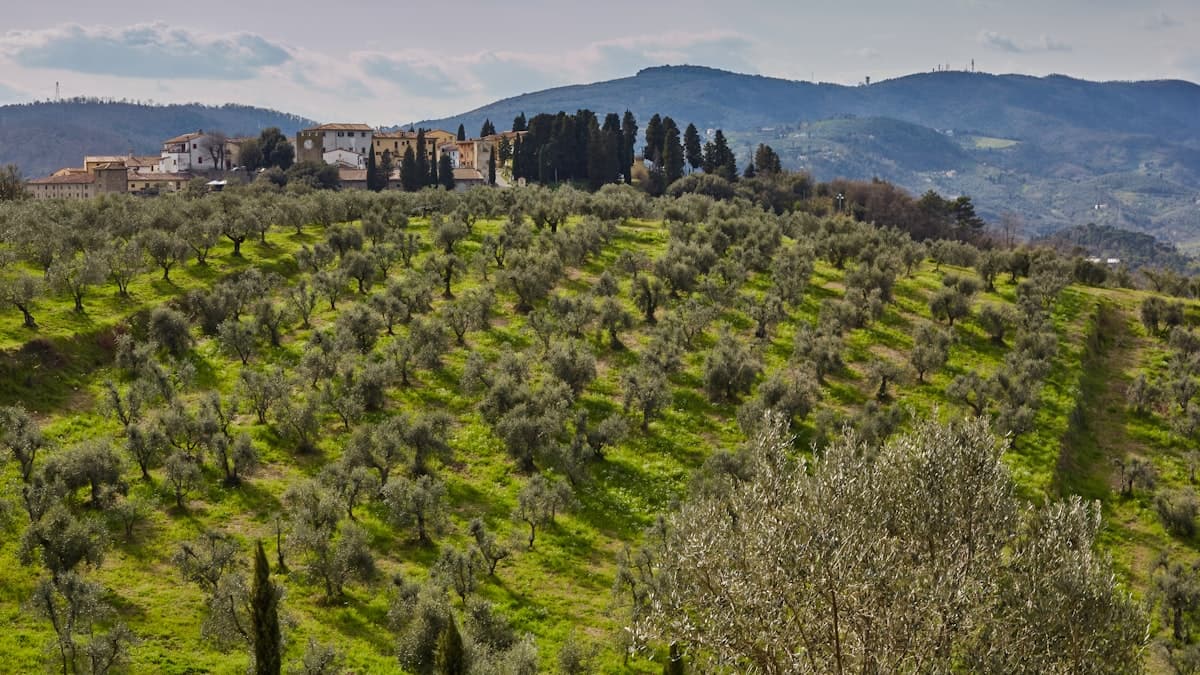
A bottle of Italian extra virgin olive oil (EVOO) labeled simply "Product of Italy" gives you almost no information about what it will taste like. Italy is less a single origin than an olive oil atlas: more than 650 cultivars are distributed across regions whose soils, climates, and traditions produce genuinely distinct results. OLEA's earlier guide on DOP and IGP protected-origin labeling covered what EU designation marks actually mean; here, we work through the sensory character of four regions worth knowing by name.
Tuscany: The Textbook Green-and-Pepper Profile
Tuscany's leading production relies on a blend of three cultivars—Frantoio, Leccino, and Moraiolo—and the oils they yield are widely regarded as the closest thing to a textbook EVOO. The sensory profile is built on green notes: fresh-cut grass, artichoke, and almond lead, with a clean bitterness that registers squarely in the middle of the tongue. The finish brings a short but distinct peppery catch at the back of the throat. Intensity sits in the medium-to-robust range.
The principal protected designations are Toscano IGP and Chianti Classico DOP. In terms of pairing, the profile is frequently recommended alongside tomatoes, legumes, crusty bread, and roasted vegetables.
Puglia: The Southern Powerhouse Behind Half of Italy's Output
Puglia accounts for roughly 59 percent of Italian EVOO production on its own. Its main cultivars are Coratina, Ogliarola, and Cima di Mola. According to regional analysis by Tasting Table, Coratina in particular is well known as a high-polyphenol variety. The oils it produces are assertively bitter, with a long-lasting pungency and prominent notes of green leaf, green apple, and almond skin. That intensity makes Puglian oils a natural fit for finishing drizzles, bean stews, and grilled vegetables.
Leading protected designations include Terra di Bari DOP and Dauno DOP.

Sicily: Sun-Ripened Tomato and Soft Green Warmth
Sicily's principal cultivars—Nocellara del Belice, Biancolilla, and Tonda Iblea—produce oils with a noticeably different character from those of the north. A lightly sweet note of ripe tomato and basil is the signature, while the green notes are softer and more rounded than in Tuscany. Overall intensity lands in the medium range.
Key protected designations are Val di Mazara DOP, Monte Etna DOP, and Monti Iblei DOP. Pairing suggestions frequently include Sicilian caponata, fish dishes, and ricotta.
Liguria: The Gentlest Profile on Italy's Northern Coast
Northwest Italy's Liguria is defined almost entirely by a single cultivar: Taggiasca. The olives are small and yield an oil that tends toward a pale golden color. The defining qualities are a soft, buttery texture and a gentle nuttiness with a faint saline suggestion; bitterness and pungency are so mild as to be almost imperceptible.
Riviera Ligure DOP is the region's primary protected designation. Pairing recommendations consistently favor seafood, pesto (whose origins trace to Ligurian Genoa), raw fish, and white-fleshed fish. Liguria is also one of the regions most often cited as an ideal introduction for readers new to EVOO.
Three Things to Read on an Italian Label
To judge where a bottle of Italian EVOO belongs in your kitchen, the label needs to give you three things together: the region of origin, the cultivar or blend, and the DOP or IGP designation. Held against those categories, the four regions map onto a fairly clear set of positions—Tuscany for the classic grassy-pepper intensity, Puglia for high-polyphenol, full-force finishing oils, Sicily for a sun-warmed medium style, and Liguria for the most delicate, seafood-friendly end of the spectrum. Keeping that framework in mind makes reaching for the right bottle considerably less guesswork.
Frequently asked questions
- Why does Italian olive oil taste so different from bottle to bottle?
- Italy grows more than 650 olive cultivars, and each of its major regions relies on a distinct set of varieties with very different sensory profiles—ranging from the grassy, peppery intensity of Tuscany to the mild, buttery character of Liguria. A label that says only 'Product of Italy' blends all of that together, which is why region and cultivar names matter when choosing a bottle.
- Which Italian region produces the most olive oil?
- Puglia in the south accounts for roughly 59 percent of Italian EVOO production on its own, making it by far the country's largest producing region.
- What does DOP mean on an Italian olive oil label?
- DOP (Denominazione di Origine Protetta) is Italy's application of the EU Protected Designation of Origin system. It guarantees that the oil was produced, processed, and prepared in a defined geographic area according to an approved specification. Examples include Terra di Bari DOP in Puglia and Riviera Ligure DOP in Liguria.
- Which Italian olive oil region is best for beginners?
- Liguria is frequently recommended as a starting point. Its Taggiasca cultivar produces a soft, buttery oil with barely perceptible bitterness or pungency—an approachable profile for anyone still building familiarity with extra virgin olive oil.
- What food pairings suit each Italian EVOO region?
- Tuscany's grassy, peppery oils pair well with tomatoes, beans, bread, and roasted vegetables. Puglia's high-intensity oils suit finishing drizzles, bean stews, and grilled vegetables. Sicily's medium-intensity oils complement caponata, fish, and ricotta. Liguria's mild oils are a natural match for seafood, pesto, raw fish, and white-fleshed fish.
Related reading
- Spain, Italy, Greece: How the Three EVOO Heartlands Taste Different
Spain, Italy, and Greece together account for more than 80 percent of the world's extra virgin olive oil, according to the International Olive Council — yet the flavors they produce could hardly be more distinct.
- Tunisia's Olive Oil Is No Longer Just a Bulk Story
Tunisia has reclaimed its position as the world's second-largest EVOO producer and is steadily expanding single-cultivar labelling — a shift that is reframing a country long associated with anonymous bulk supply.
- Koroneiki: The Cultivar Behind More Than Half of All Greek EVOO
One cultivar accounts for the majority of Greece's extra virgin olive oil output. Here is why Koroneiki became the country's industry standard — and what to look for on the label.
- Beyond Tuscany: The Italian EVOO Estates Worth Knowing in Umbria and Sicily
Premium Italian extra virgin olive oil extends well beyond a Tuscany IGP label. From Carmignano to Palma di Montechiaro, three regions and their benchmark estates mapped out.
- Andalusia: How One Region Came to Produce a Third of the World's Olive Oil
From Phoenician traders to single-estate pressing, Spain's Andalusia has held its place at the center of global olive oil production for more than a thousand years. A look at the history behind the world's largest EVOO-producing region.
- California and Australia: The New-World EVOO Producers Now Setting Their Own Standards
In roughly thirty years, California and Australia have built industrialized EVOO sectors complete with their own certification bodies. A look at what COOC and AOOA seals mean, and why Cobram Estate now presses about 65 percent of Australia's annual crop.