Guides
Climate Change Is Redrawing the Olive Oil Map: Andalusia, Puglia, and What Comes Next
The International Olive Council projects global olive oil production at around 3.44 million tonnes for the 2025/26 season — roughly 4% below the previous year. Heat waves in Andalusia, drought in Puglia, and the spread of Xylella fastidiosa are reshaping both producer rankings and retail prices.
Translated from the Korean edition, originally published June 4, 2026 · read the original
According to data published by the International Olive Council (IOC) in December, global olive oil production for the 2025/26 season is projected at approximately 3.44 million tonnes — roughly 4% below the previous year. Markets are paying close attention because analysts regard this not as a one-season blip but as part of a structural shift: heat waves in Andalusia, drought in Puglia, and the spread of disease are simultaneously pressing on retail prices and redrawing the geography of production.
The EU Harvest Steps Back
The USDA has revised its EU olive oil production estimate for the same season down to approximately 2.055 million tonnes. While that figure still exceeds the five-year average, it represents a clear retreat from the recovery seen in 2024/25. Industry observers consistently point to three converging pressures: summer heat combined with insufficient autumn rainfall, regionally intensifying drought, and the spread of pathogens and pests — Xylella fastidiosa and the olive fruit fly chief among them.
Spain: A Strong Start Eroded by Summer Heat
Spain is forecast to produce around 1.37 million tonnes in 2025/26. A promising spring rainfall offered a good opening, but summer heat waves and a brief, inadequate autumn rainy season cut into yields. According to USDA data, Andalusia's output fell roughly 5% year-on-year while Castilla-La Mancha dropped nearly 17%. Extremadura, by contrast, rose around 5%, and Catalonia posted a rebound driven by a low base effect from the prior season.
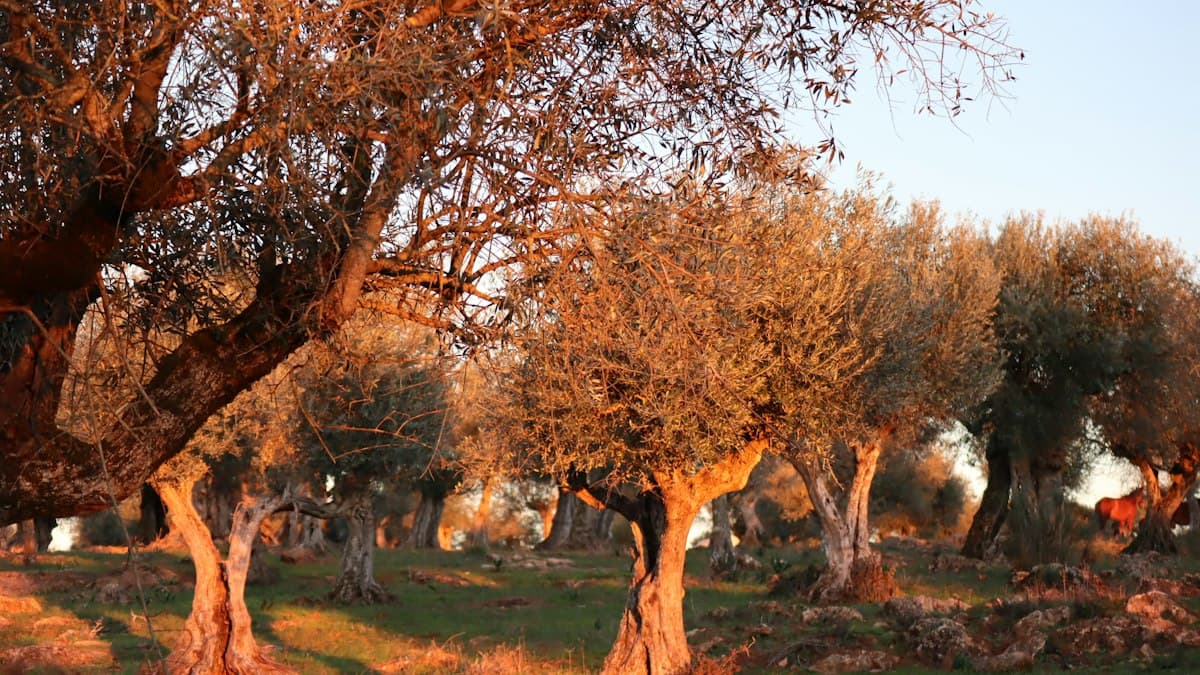
Field reports from Granada and Málaga — areas within Andalusia that lack irrigation infrastructure — describe yield losses of 30–70% where heat and drought struck simultaneously. The implication is significant: the centuries-old production geography of Andalusia is being redrawn along irrigation lines, with irrigated farms and non-irrigated farms diverging sharply in resilience.
Italy: Puglia Under a Double Burden
Italy's 2025/26 production outlook stands at roughly 300,000 tonnes — enough to cover only about 30% of domestic consumption and export demand combined, with the remainder effectively sourced through bulk imports. Puglia, which accounts for approximately 59% of Italian output, is carrying two simultaneous burdens: summer drought that leaves trees stressed by the time the autumn harvest arrives, and the ongoing spread of Xylella fastidiosa, the bacterium that causes olive trees to wilt and decline. Multiple data sources suggest that Puglia's share of Italian production may gradually contract — a trend consistent with what OLEA has covered in its guide to Italy's four regional characters.
The Map Is Shifting Sideways
As climate pressure accumulates, the geography of olive oil production itself is moving. Tunisia has risen rapidly in both quality and export share since the 2024/25 season, emerging as a significant origin in the way OLEA explored in its guide to Tunisian EVOO. California and Australia have held relatively stable harvests, supported by different latitude profiles, water access, and irrigation systems — dynamics covered in OLEA's New World producer guide. Within Europe, super-high-density orchards equipped with irrigation are expanding quickly across Andalusia and Portugal. Even the spread of Arbequina as a single cultivar — from Catalonia down through Andalusia — is partly an agronomic response to climate stress, chosen for its adaptability under heat and water pressure.
Prices: Two Directions at Once
Retail prices are being pulled in two directions simultaneously. In the short term, analysts suggest prices could hold in a range roughly 30–40% below their recent peak for an extended period. Over the medium term, however, the prevailing view is that the persistent autumn rainfall deficits flagged consistently by both the IOC and the USDA will feed through to next season's supply and revive upward pressure. The price dynamics OLEA outlined in its explanation of why olive oil prices rise — harvest cycles, climate, and exchange rates — remain valid; what has changed is the time horizon. Rather than an acute shock, the market is entering a phase in which slow-accumulating climate stress is steadily, if quietly, being priced in.
What to Check at the Shelf
A few label habits are worth forming given this environment. The harvest year remains the single most useful starting point: acidity and intensity can shift meaningfully between seasons even within the same appellation. Labels that once read exclusively "Spain" are increasingly showing Tunisia, Portugal, or Greece — a natural consequence of diversifying origins. DOP and PGI designations are among the indicators most directly affected by local climate variability. And farm-level information on irrigation practices — once an afterthought — is appearing more often on labels and producer pages precisely because it has become a meaningful differentiator. The five-point label checklist in OLEA's how to read an olive oil label now has an effective sixth variable: climate context.
A Structural Shift, Not a Season
Climate change has moved from the category of seasonal event into something closer to a permanent variable — one that is slowly but continuously redrawing the map of where the world's olive oil comes from. Checking origin, harvest year, and acidity on the label has become more meaningful than ever.
Frequently asked questions
- Why is global olive oil production falling in 2025/26?
- According to the International Olive Council, the main factors are overlapping summer heat waves, insufficient autumn rainfall, and the continued spread of pests and diseases — particularly Xylella fastidiosa in Puglia and the olive fruit fly across several regions. The IOC projects 2025/26 output at around 3.44 million tonnes, approximately 4% below the prior season.
- How much has production dropped in Spain and Italy?
- Spain is forecast to produce around 1.37 million tonnes in 2025/26, with Andalusia down roughly 5% year-on-year and Castilla-La Mancha down nearly 17%, according to USDA data. Italy's outlook stands at approximately 300,000 tonnes — enough to cover only about 30% of its domestic consumption and export demand, with the shortfall largely met by bulk imports.
- Which olive oil producing regions are growing as traditional ones struggle?
- Tunisia has seen rapid gains in both quality and export share since the 2024/25 season. California and Australia have maintained relatively stable harvests due to differences in latitude, water resources, and irrigation infrastructure. Within Europe, super-high-density orchards with irrigation systems are expanding quickly in Andalusia and Portugal.
- Will olive oil prices go up again?
- In the short term, prices are expected to hold at levels roughly 30–40% below their recent peak. The medium-term outlook is less certain: both the IOC and the USDA consistently flag insufficient autumn rainfall as a factor that could feed into reduced output next season and renew upward price pressure. The current situation is less a one-off shock than a slow accumulation of climate-related stress.
- What should I look for on an olive oil label given climate variability?
- The harvest year is the most important starting point, since acidity and flavor intensity can shift significantly between seasons even within the same region. DOP and PGI designations reflect origin conditions and are among the first indicators affected by climate variability. Increasingly, producers are disclosing irrigation practices on labels and brand websites — information that has become more meaningful as drought stress differentiates farms within the same appellation.
Related reading
- EVOO Prices Are Easing — Here's Why They Rose and How Far They've Fallen
Global extra virgin olive oil wholesale prices hit record highs in the 2023–24 season and are now retreating. Harvest conditions, climate shocks, and the structure of the supply chain each play a distinct role in how prices move.
- Andalusia: How One Region Came to Produce a Third of the World's Olive Oil
From Phoenician traders to single-estate pressing, Spain's Andalusia has held its place at the center of global olive oil production for more than a thousand years. A look at the history behind the world's largest EVOO-producing region.
- Arbequina: From Catalonia to Andalusia's Super-High-Density Groves
The most common single-cultivar extra virgin olive oil on global shelves did not originate in Andalusia. This guide traces Arbequina from its Catalan home village to the intensive groves that now define its commercial reach.
- Burning Groves: How Wildfire and Air Pollution Are Reshaping Olive Oil Country
The Mediterranean produces around 95% of the world's olive oil — and it is heating up faster than almost anywhere else on earth. From scorched root systems to smoke-tainted harvests, environmental disaster is leaving marks on olive groves that last far longer than the flames.
- Spain's Top EVOO Estates: A Guide to the Names That Keep Winning
Not all single-estate Spanish olive oils occupy the same tier. From Jaén and Granada to the Tabernas Desert and Extremadura, this guide maps the Spanish houses that international competition judges and critic guides return to year after year.
- Castillo de Canena: How a 1780 Family Estate Became a Biodynamic EVOO Benchmark
A single Andalusian estate has been farming olives on the same land since 1780 — yet the premium reputation that precedes Castillo de Canena today was built largely in the last two decades, through biodynamic certification, cultivar transparency, and a deliberate repositioning in the global EVOO market.
Tags
- climate change
- olive oil production
- andalusia
- puglia
- evoo